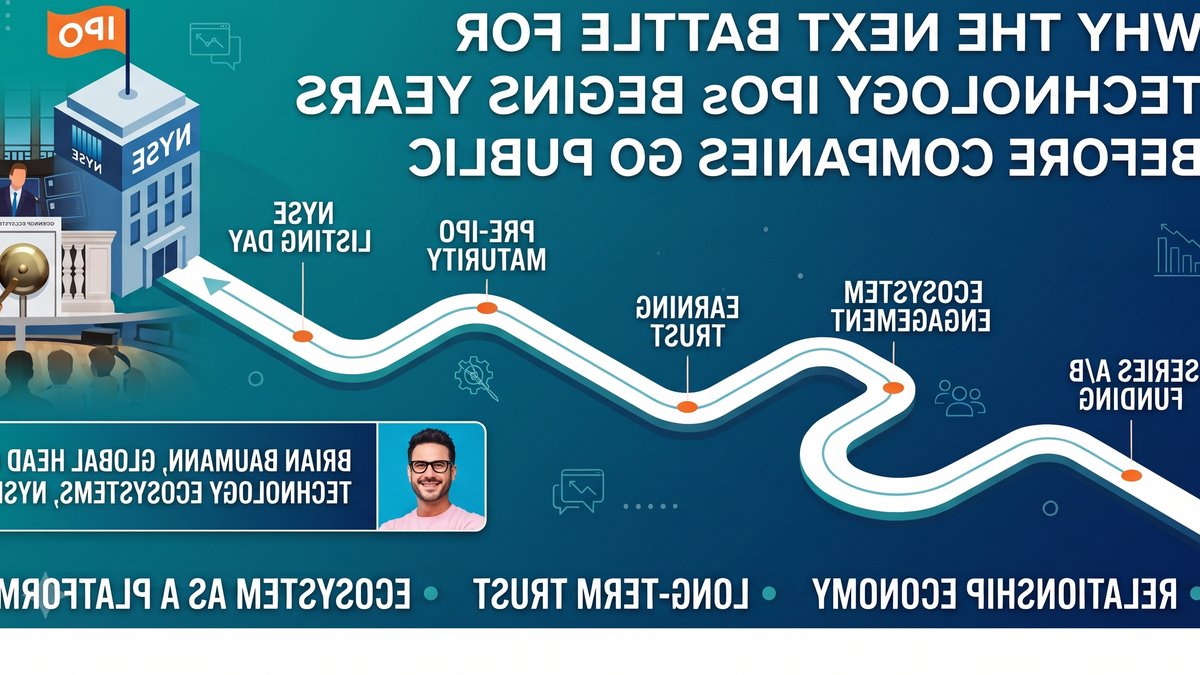
The New York Stock Exchange has quietly begun a long-term strategy to secure future listings by building relationships with technology companies years before they go public. While the opening bell on listing day often grabs the spotlight, exchanges are increasingly focusing on the years leading up to that moment. As artificial intelligence companies stay private longer and venture-backed firms mature at unprecedented scale, earning trust years before an initial public offering has become a strategic imperative for global exchanges.
Technology companies don’t wake up one morning and decide where to list. Those decisions are shaped over years through relationships, trust, shared experiences and credibility. Founders remember who showed up before they needed anything, and enterprise leaders remember who invested in understanding their businesses. This long-game approach has increasingly become part of how the NYSE engages the innovation economy, expanding its reach across AI infrastructure, enterprise software, cybersecurity and digital assets while many of those companies are still private.
Related: Google developing Frozen v2 chip for Gemini AI
According to figures shared internally by NYSE, NYSE Wired has engaged more than 2,600 entrepreneurs, connected with more than 5,000 enterprise practitioners, produced more than 1,000 media sessions and participated in more than 100 events since its inception. Those numbers matter less as isolated media metrics than as indicators of sustained engagement. They are powered by an even deeper foundation: over the course of 16 years, SiliconANGLE and theCUBE have interviewed more than 17,000 technology leaders, published more than 100,000 blog posts and cultivated an active audience of tens of millions of users.
When you layer NYSE Wired onto this massive existing community network, every conversation creates deeper familiarity. Every interview expands an already colossal ecosystem. A prime example of this model in action is recent coverage of Jonathan Hurst, co-founder and chief robot officer of Agility Robotics. By providing a trusted platform to discuss the commercial scale of physical AI and humanoid deployment, the ecosystem acts as a bridge between deep tech innovation and the capital markets long before a transaction occurs. Unlike traditional transaction-oriented engagement, this joint model is designed to compound. By the time many founders begin evaluating public-market options, they don’t just know the institution — they are already deeply embedded within its broader platform.
One of the more interesting lessons from NYSE Wired is that once a trusted community reaches critical mass, it scales beyond media into an operational ecosystem, one capable of introducing new communities, services and partnerships that create value well before a company reaches the public markets. Founders don’t just want visibility; they need customers, talent, strategic partners and access to expertise. By shifting from a media collaboration to a platform model, NYSE Wired can introduce specialized capabilities that help companies actively build their businesses. This includes executive roundtables, industry research and specialized developer networks.
Related: Alibaba unveils new AI model Qwen3.8
Under Chief Executive Lynn Martin, NYSE has invested significantly in modernizing how the exchange communicates with markets, companies and investors, while broadening the institution’s engagement with the innovation economy beyond the traditional listing process. The evolution represented by NYSE Wired wasn’t about replacing those investments. Instead, it was about extending them. The lesson has been that media, when combined with community and trusted relationships, can become more than a communications function. It can become part of business development. It can help institutions participate earlier in innovation cycles. It can create long-term familiarity rather than short-term visibility. And perhaps most importantly, it can build trust before transactions begin. That distinction is increasingly important in industries moving as quickly as artificial intelligence, cloud infrastructure, cybersecurity and digital assets.
Baumann’s expanded mandate formalizes many of these ideas. As global head of technology ecosystems, he has a responsibility that extends beyond traditional capital markets to cultivating relationships with the next generation of technology companies across key sectors while helping shape how NYSE engages emerging innovation communities around the world. It’s an acknowledgment that ecosystem development deserves institutional focus rather than remaining an experimental initiative. The broader lesson extends beyond the NYSE itself. Institutions are increasingly discovering that trusted media, executive communities and relationship networks are becoming strategic assets in their own right. Rather than treating content as a marketing expense, organizations are beginning to use it as infrastructure for long-term engagement, market intelligence and ecosystem development. Financial institutions that invest in building trusted relationships years before financing events, listing discussions or market cycles will always be better positioned than those relying solely on transactional pitches. NYSE’s creation of the global head of technology ecosystems role formalizes this reality. In today’s innovation economy, content acts as the infrastructure, community is the product, and trust built years before the opening bell is the ultimate competitive advantage.


