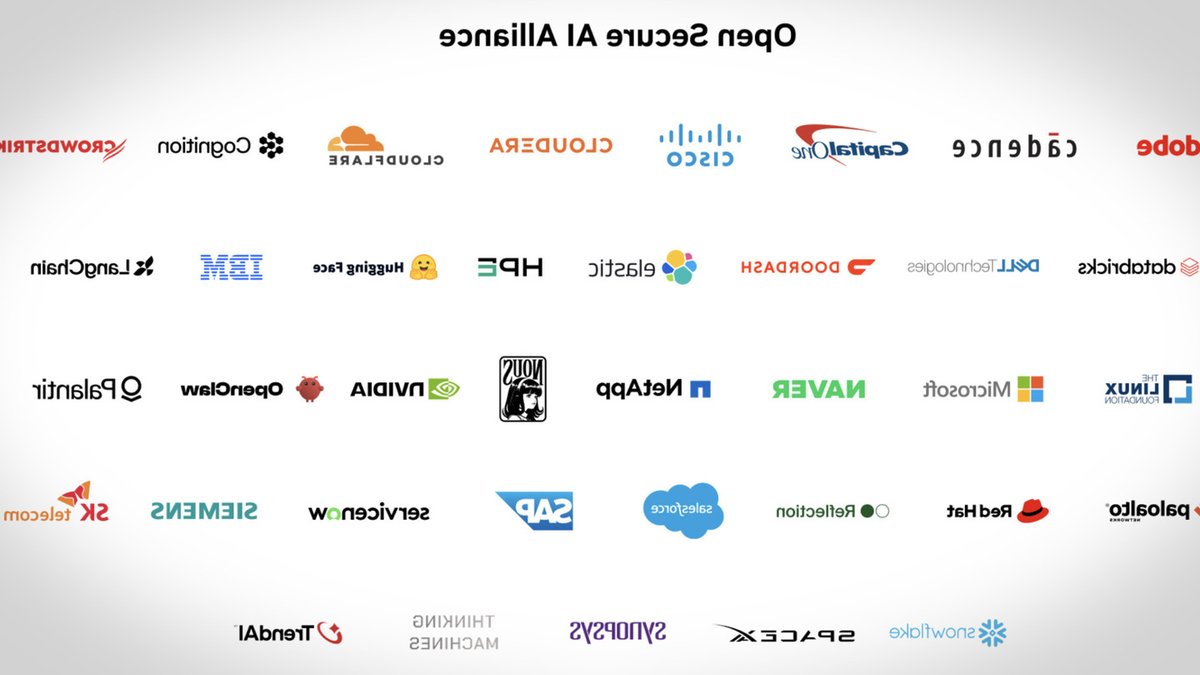
The tech industry’s latest collaborative effort, the Open Secure AI Alliance, was announced this week as a joint initiative aimed at strengthening cybersecurity defenses amid rapidly evolving artificial‑intelligence threats.
Founding members and stated purpose
Among the 27 founding organizations are NVIDIA, Microsoft, Dell, the Linux Foundation, SpaceX, IBM and Red Hat. The alliance builds on the Linux Foundation’s Akrites program and the OpenSSF community’s work, according to the announcement from NVIDIA. Its stated goal is to “remediate and disclose vulnerabilities using open technologies,” a mission that reflects growing concerns about the security of both proprietary and open‑source AI models.
Members plan to share model weights, data sets and new agent frameworks to accelerate the creation of security tools. Hewlett Packard Enterprise will contribute standards for cryptographically verifying AI agents, while Hugging Face will provide a safe storage format called Safetensors. The consortium also urges governments to treat open models as defensive assets rather than liabilities.
Why open and closed models matter for defense
The alliance points to a recent incident involving Hugging Face as evidence that reliance on closed AI tools can hinder incident response. In that case, the company first attempted to use commercial frontier models to analyze a breach, but the tools’ safety guardrails blocked the analysis. Switching to an open‑weight GLM 5.2 model allowed Hugging Face to examine more than 17,000 actions and contain the intrusion, the group noted.
Related: Cleaning Your USB Ports Made Easy
“When closed AI tools — unable to distinguish attackers from defenders — blocked essential forensic analysis, Hugging Face ran the open‑weight GLM 5.2 model on its own infrastructure to analyze more than 17,000 actions and contain the intrusion,” the statement read.
The alliance argues that security researchers need access to both open and closed frontier models to defend against attacks leveraging advanced systems such as Anthropic’s Mythos 5. By making open models readily available, the group hopes to reduce dependence on a narrow set of commercial providers.
Looking ahead, the consortium’s members may face challenges aligning diverse corporate priorities while maintaining the openness required for rapid vulnerability disclosure. The balance between transparency and the risk of exposing exploitable details is delicate, and the alliance will need clear governance to avoid unintended consequences.
Regulatory context and industry response
The announcement arrives as the U.S. government weighs broader restrictions on Chinese open‑source AI models, according to the report. Those models have been gaining traction because they are often cheaper than closed alternatives from firms like OpenAI and Anthropic. By contrast, major commercial AI developers such as Meta and Google are not part of the alliance, a fact that highlights the coalition’s focus on open‑source contributors.
Related: Global tensions fuel demand for risk intelligence
Regulators are being asked to recognize the defensive value of open AI assets. The alliance warns that blanket bans on frontier AI systems could “weaken defensive capacity and risk concentrating power” among a few closed‑source providers. It also calls for shared investments in open AI infrastructure, suggesting that coordinated public‑private effort could improve resilience across the sector.
In the short term, the alliance’s success will depend on how quickly members can deliver usable tools and standards to the broader security community.
Success will hinge on rapid delivery.


